
Can Australia build one of the world’s largest data centres?
Even if we can pull off the logistical feat, given the social and environmental impact, the question remains: should we?
By Bronwyn Cumbo & The Conversation Digital Storytelling Team.
Published February 10, 2026
It takes just a few seconds for an AI model such as ChatGPT to make your wish come true.







But generating this silly AI video requires a lot of energy – roughly 940 watt hours – which is akin to running a microwave for over an hour.
Now think of millions of people making similar requests.
That’s a lot of energy being used.
And for this, we need data centres.
Far more data centres. Far bigger data centres. Like the Mamre Road Data Centre proposed for Sydney’s west, that at 1 gigawatt, would be one of the biggest built anywhere in the world.
But can it actually be done? And given the environmental impacts, should it be done?
What are data centres?
The computers that generate your dancing cat videos and answer all your questions aren’t like your computer at home. They don’t have screens or keyboards and they live in special temperature-controlled buildings.
AI data centres work as one supercomputer with hundreds of thousands of interconnected specialised computer chips known as graphics processing units – or GPUs – which process the billions of requests people send to AI programs each day and train the models that underpin them.
There are also other kinds of data centres, called co-locators, which act like landlords by renting out server space to clients looking to outsource their AI and data processing, cloud computing and storage needs.
All require a huge and uninterrupted supply of electricity and water to keep them running and cool.


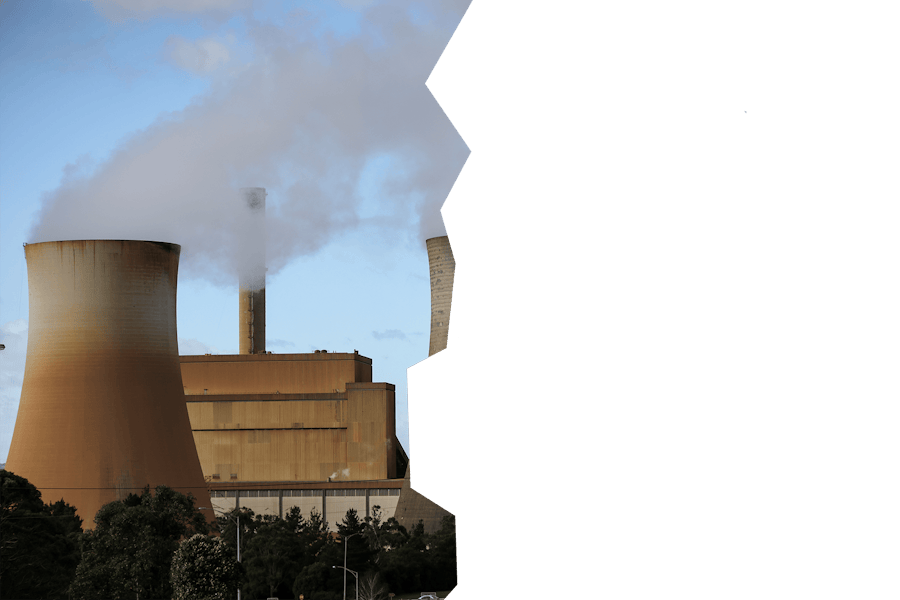
 45%
45%
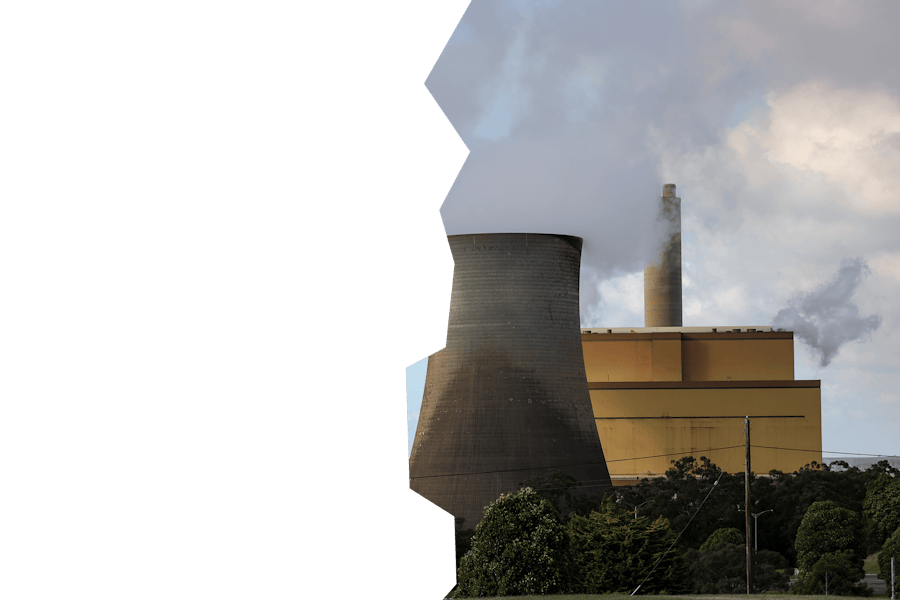
A 1GW data centre, like the one planned for Sydney’s west, would use almost half the power from Victoria’s Loy Yang A coal power plant, if both ran at full capacity.
330m tall
If 1GW of power was continuously produced by a coal plant it would release approximately 6.3 million tonnes of C02 annually, which would fill a balloon about 1,800m wide.

If you powered it with solar, you’d need a plant twice the size of anything that exists in Australia, with 2.8 million solar panels.
This spot just north of Western Sydney Airport is earmarked for Australia’s largest data centre, the 1GW Mamre Road Data Centre Campus. If approved, it’ll join more than 90 data centres operating in Sydney alone, with another 20 under assessment.
The industrial-zoned site is currently a grassy paddock, covered in dams and livestock tracks, and is next to an Amazon warehouse and two local schools. It’s not small – about the size of 52 rugby fields.
There are four key parts of any data centre development: chips cooling water energy It’s a massive undertaking for a project of this scale, so we’ve tracked the major hurdles it’s going to face.
Chips
These six four-storey buildings will make up the core of the
Mamre Road campus. Inside, hundreds of thousands of computer
chips will live in special cabinets, called racks.
The chips themselves are eye-wateringly expensive. While we
don’t know exactly which type they’ll use, the leading NVIDIA
chips costs about
US$32,000
(A$45,800) each.
Just sourcing the chips is a considerable challenge. Global demand for them is rising and with China on the verge of being granted access to NVIDIA chips, the supply will be increasingly tight. Any new data centres will need to join the queue waiting for production to catch up.
Cooling
The chips need continuous cooling to
around 5–30°C
to avoid overheating and emergency shutdown. Without effective
cooling, a 1GW data centre would overheat within a matter of
minutes.
The Mamre Road campus will have 936 large-scale air conditioners,
likely placed around the edges of the building and on the roof to
save land space.
Water
These are the 66 water tanks
planned
for the centre as backup supply.
Data centres need huge amounts of water for cooling, up to
40 million litres a day. That’s the equivalent usage of about 80,000 households.
Data centres currently use about 3.5 billion litres of water per year in Sydney alone – less than 1% of the total demand. Sydney Water is predicting that will jump to 25% by 2035.
The source of that water is contentious and data centre developers aren’t required to show projections on how much water they will use.
Sydney Water is exploring options to supply new data centres in Western Sydney with recycled water, which would require the building of new recycled water plants, pipes, and associated infrastructure.
But right now, at least 89 data centres are drawing directly from the public drinking water supply.
Energy
These are the substations that will take in the high-voltage power from the grid and convert and stabilise the electricity to power data processing and cooling.
The majority of data centres rely on Power Purchase Agreements (PPAs) to meet net zero targets. While PPAs enable data centres to buy wind or solar power, the actual energy used often comes from fossil fuels, as wind or solar energy is intermittent and often generated far from the facility.
It’s also not clear how domestic power bills will be affected, though some data centres in the US have pushed prices 267% higher for local residents.
There’s no way to switch off or quickly scale back operations if there’s too much demand on the energy grid at peak times. The centre will have 852 backup diesel generators, with more than 14,000 kilolitres of diesel storage and roughly 7,500 cabinets to store lithium-ion batteries.
Those diesel generators would need to be tested regularly, which causes noxious air pollution.
No one has ever built a data centre on this scale in Australia.
Could you, should you?
The centre is set to be bought by American-owned AirTrunk, which has 12 data centres running or in development in five countries.
“The way I see AI, this is the biggest single biggest gold rush in human history. It’s going to generate so much wealth for everyone,” AirTrunk’s founder Robin Khuda told Forbes last year.
But major AI companies are losing billions of dollars each year and there are already examples of newly-built, mega data centres sitting idle because of energy supply constraints.
So even if you could technically build a data centre of this size, should you?
The federal government – along with the tech industry – is trying to position Australia as a regional data centre hub to support AI demand.
To this end, it’s currently finalising a set of national data centre principles in partnership with the states and territories that will reportedly streamline development approvals.
This is despite concerns about whether power grids can handle the massive power demands – and whether the data centre boom is compatible with net zero targets.
Data centre developers globally are looking to secure power, with Microsoft reopening the nuclear plant in Pennsylvania, in the United States and Musk buying a former gas plant site for xAI’s Colossus 1 and 2 supercomputers in Tennessee. Musk’s Colossus centre also ran 35 illegal gas turbines to generate their energy – a move that sparked a lengthy legal battle with the US Environmental Protection Agency and the local community.
Last week, Melbourne’s lord mayor, Nicholas Reece, warned data centres could “cook the planet” and called on governments to better manage them.
The New South Wales parliament has established an inquiry to investigate data centre development in the state.
Even some in the tech industry acknowledge the problems.
“Global electricity demand for AI simply cannot be met with terrestrial solutions, even in the near term, without imposing hardship on communities and the environment,” Elon Musk’s aerospace firm, SpaceX, said in a statement last week announcing it had acquired his AI company, xAI.
Musk’s proposed solution – which is shared by others – is to build data centres in space. But this would come with its own set of challenges, transform our night sky, and create irreversible impacts in space.
Amid this rush, it might be worth pausing to look more closely at the dream we are chasing. AI is not a monolith, and while some uses offer real promise, such as medical research, others have dubious value and have already caused serious harm, such as Grok’s sexualised images of children.
Governments, industries, communities – all of us – need to become more discerning about where AI might live up to the hype – and where it simply isn’t worth the cost.
And as anyone who's ever watched a cat video knows, that's not always an easy line to draw.
Authors
Lecturer, Transdisciplinary School, University of Technology Sydney
Editorial production
 The Conversation Digital Storytelling Team
Development and design
Deputy Science + Technology Editor
 Matt Garrow
Editorial Web Developer
 Ashlynne McGhee
Head of Editorial Innovation
Disclosure
Bronwyn Cumbo receives funding from the Australia Public Policy Challenge Grant for her research investigating possibilities and challenges to establishing New South Wales as a sustainable data centre hub.
Correction: this article originally stated the diameter of a sphere of 6.8m tonnes of CO2 at standard pressure and temperature was 280m. This has been amended to 1,800m
 Built with Shorthand